
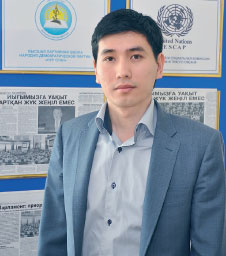
written by Assylkhan Nurgaliyev
Ph.D. student in Social Policy and Administration at The University of Nottingham
Astana, Kazakhstan, 2011
The President of Kazakhstan has established a new aim for the industrial and innovative development of the Kazakhstani economy by impoverishing new business ideas. The young generation of Kazakhstanis highly supports the President’s vision, as it aims to improve young people’s futures.
Today, three factors are needed for the development of the Kazakh state. Firstly, the different social groups in Kazakhstan need to be united by a single will. Secondly, there should be a firm state policy which strengthens national interests. Thirdly, human capital must be developed; otherwise, a young, patriotic generation of professional administrators and governors must be educated. The last point is crucial, as it affects the possibility of innovative and industrial modernization of Kazakhstan and the implementation of all significant plans, which can only become real if there are people who can fulfil those plans.
In this regard, it is interesting to recount the story of the father of Abai, the greatest Kazakh poet, philosopher and thinker. His father, Kunanbai, was the governor of the Semey region in Eastern Kazakhstan. Kunanbai was educated and a wealthy aristocrat who paid much attention to the education of the young generation. It is known that Abai received both an Islamic and a European education because of the help and will of his father. Kunanbai supported talented youth, which then became a feature of Abai’s personal character. Many Russian thinkers who were travelling or living in Eastern Kazakhstan, scientists and politicians who were arrested by the Tsarist regime and sent to Kazakhstan, and Kazakh poets were all guests of Kunanbai. Abai used social occasions for his own self-development to increase his knowledge, as a person learns more helpful information during a live discussion than by being part of the audience for a lecture.
Being the sultan (governor), Kunanbai was a strong, organized person and administrator with a strict character. It is helpful to study his method of administration, as it shows how Kunanbai was trying to raise responsible, patriotic and skilful young Kazakhs. The valuable notion was that Kunanbai always tried to participate in special events and weddings of young people living in his territory. At the same time, Kunanbai gave presents to young married couples in the form of cattle or other domestic equipment. However, the most significant thing was that Kunanbai gave land to new families to develop young husbands’ administrative skills and underpin their love for their native land and their responsibility for the wellbeing of their relatives. However, the only requirement Kunanbai requested from married couples was a careful attitude to the land given to them. If the young couple could not take good care of the land, then Kuanbai had a right to recover it and entrust the land to another couple. The main criterion for Kunanbai was effective administration of his territory (Kipshakbaiyev, 2009).
According to the tradition of nomads, changing the area of land on which people live and breed their cattle is vital, as the constant use of a particular area slowly but surely destroys its livability. Cattle reproduction and growth also depend on organizational skills. Through this practice, Kunanbai was trying to show that land and resources could not be administered carelessly.
Nowadays, living in a market economy, it seems that Kunanbai was acting in the right way. When the person feels that he or she owns the property, he or she starts to value and care for his or her possession and thinks about how to enlarge it and at least save what he or she already has. Sometimes, looking at the actions of so-called “top managers” who have administered national wealth poorly, there is a wish that ‘the principle of Kunanbai’ had applied to them. If you cannot manage the resources entrusted to you, be honest and give the opportunity to another person who will manage it properly and responsibly.
There was an attractive fact in the history of the Russian Empire when Tsar Nikolai II used to collect reports from Government members and regional governors during his holidays at his residences. It was usual that the Emperor did not have enough time to read them all. Moreover, many of those reports had similar content and repeated statistics from the preceding years. However, the reports were necessary to show the progress of work implementation over a specific period, even if Emperor Nikolai was not interested in them. Nevertheless, the Emperor once took a letter in which a regular governor of one of the Russian provinces, Stolypin, was describing the mechanisms of the modernization of the Empire. Peter Stolypin soon became the Russian Empire’s Prime Minister and, with Emperor Nikolai’s support, had the chance to make many effective and significant decisions that would benefit the state. After the reforms, which Stolypin initiated, the Emperor of Prussia, Wilhelm, told Nikolai during a private conversation that the social and economic reforms of the Russian Prime Minister were much more effective than the policies of his famous Prime Minister, Bismarck (Solzhenitsyn, 2008: 5–143). It was Nikolai’s personal talent to discover, mark, and promote skilful administrators of new formations.
Contemporary Kazakh literature and academic papers try to reflect the diversity and complexity of the Kazakh nation’s history and culture. However, according to local critiques, Kazakh society today seems to focus much on the materialistic side of social life rather than on art, science, and knowledge. Therefore, there is an absolute necessity for the spiritual and mental enrichment of the young generation.
Historian and writer M. Suleimanov (2009) recently wrote a book devoted to the ancient formula of the great Genghis Khan, which was universal in the Kazakh steppe. The author described the principles that were the main criteria for Khan in training future administrators for his Empire.
Thus, Genghis Khan always divided personalities into two kinds. The first kind consisted of individuals who, in his opinion, were truthful about their occupation and were real professionals, whereas the second kind acted only in terms of their own self-interest and not in the interests of the state or society members. Khan gave much attention to the issues of morality among his entourage.
Moreover, today, due to research, a large audience has become familiar with the ancient nomadic principles of state administration, such as the ‘Jasa’ of Genghis Khan and the ‘Power’, ‘Authority’ and ‘Army’ of the past. Notably, all these principles had one common feature: the aim of finding and supporting people who were faithful and displayed honour and morality in their profession and for whom it was important to implement their task honestly rather than to seek material benefits. According to Suleimanov, Genghis Khan named such personalities, who were faithful and reliable, the ‘ar isi’ (which in the ancient Kazakh language meant “truthful and responsible execution”) (Suleimanov, 2009: 23). Afterwards, this term was used in the 1930s in Nazi Germany to indicate the “nation of higher origin”, also known as the ‘Aryan race’ (Wildman, 1996: 87). However, initially, in the era of Genghis Khan, this terminology was in use for the description of a person with distinctive professional and moral traits and strong administrative skills.
Genghis Khan saw people who were mainly occupied with their self-interest, who had a wish for material possessions and personal safety and lacked dignity, as potential traitors. In Genghis Khan’s belief, such people were honest with their rulers only because of fear. At that time, it was the ruler’s priority to deprive properties of their men. Therefore, such people did not see beyond the limits that their masters had identified. That was the reason why Genghis Khan supported and encouraged initiative, creativity and bravery in his people’s decisions concerning military or public questions. People who only cared about their self-being and self-preservation could not be inventive and valuable to society. Therefore, it was natural for Genghis Khan that such people could easily betray their masters purely because they wished to increase their material possessions and avoid any responsibility or obligation. Therefore, Khan found such people to be ‘psychological slaves’ and was forced to dismiss them from his state apparatus and the right to govern the population of his Empire (Myzun, 2005, in Suleimanov, 2009: 124).
Moreover, during his invasions of new lands and states, Genghis Khan attracted to his side those opponents who fought with him until the last moment of battles and were devoted to their former governors. Genghis Khan believed such people would adhere strictly to their beliefs in any situation, and with the help of such individuals, Khan began to build his Empire (Kalashnikov, 1985: 337).
Khan faced difficulties that governors often encountered when they formed the state apparatus. Most of the representatives of the nomadic elite were opposed to Genghis Khan’s attempts to centralize and institutionalize the state power and strengthen the role of the state among tribes. Indeed, those representatives did not care about the state, as they were mainly concerned with their status in society and their power and were not thinking about a united and powerful country. Aristocracy was seeking independence and sovereignty from the state. However, Genghis Khan was aware of the destabilizing moods of people in power and, therefore, made necessary decisions by replacing the representatives of the old aristocracy with new ones. Despite a constant, exhausting search lasting 30 years and which experienced many difficulties and mistakes, Genghis Khan could find talented and skilful commanders and governors for his Empire, people whom he later named the real ‘aristar’ or “aristocrats of the spirit”. At first, many of the new ‘aristar ‘did not support Genghis Khan. However, seeing his truthful reign, they accepted his power later. The 30-year period defined individuals for Khan, who had, in his perception, a moral right to govern the state. Certainly, it was uneasy for Khan to accept the fact that the process of selection was followed by a constant war among tribes and groups, but this was a way to identify the “real” state administrators (Suleimanov, 2009: 164).
One of the key principles of Genghis Khan’s method of administration was objectivity. This notion underpinned the practice of Khan judging and assessing both the old and the young without concern for their material prosperity and rank. This practice enabled young, talented public administrators to reach high governmental positions, as Khan listened to their knowledge and thoughts. For instance, nowadays, there are many sources which admit the talent, humaneness and strategic mind of Zhaushy, the first son of Genghis Khan, whom Kazakhs greatly respected for his deep knowledge of the issues of governance and therefore was named the ‘Alash-khan’, which meant “truthful khan”. To Genghis Khan’s credit, he could teach his son Zhaushy in such a way (Suleimanov, 2009: 191).
The issue under discussion is significant for Kazakhstan, as the region faces difficulties. In the post-industrial twenty-first century, the region faces rapid population growth problems and scarcity of resources, including limited water, land, and natural resources. Therefore, the issue of the formation of skilled and intellectual cadres becomes crucial and decisive.
In conclusion, it is worth admitting that Kazakhstan needs highly professional and ideological patriots, skilful public sector administrators of social affairs, and strategic national resources. In the next few years, Kazakhstan must modernize its social and economic potential, strengthen its democratic institutions and underpin its political course. These intentions are possible only if the state has young people who are qualified and eager to lead the country with enthusiasm in the new era of challenges and responsibility.
Bibliography
Myzun, U. (2005). ‘Khans and Governors’ The Golden Orda and Russian knyazhestva’, in Suleimanov, M.H. (2009). ‘The era of Genghis Khan in Kazakh history’. Zerger Ilyas Press, Almaty, Kazakhstan.
Kalashnikov, I.K. (1985). ‘The cruel century ‘. The Sovremennik Press. Moscow, Russia.
Kipshakbaiyev, N.K. (2009). Conversation on the ‘Story about Kunanbai ‘. November 2009. Astana, Kazakhstan.
Solzhenitsyn, A.I. (2008). ‘Tsar. Stolypin. Lenin ‘. U-Factor Press. Moscow, Russia.
Suleimenov, M.H. (2009). ‘The era of Genghis Khan in Kazakh history ‘. Zerger Ilyas Press. Almaty, Kazakhstan.
Wildman, S.M. (1996). ‘Privilege Revealed: How Invisible Preference Undermines America’. New York University Press. The United States.
 Assylkhan Nurgaliyev